Why Your Gym Needs More Than a Spreadsheet: A Guide to Membership Management
Still managing your gym on Excel or Google Sheets? Discover why spreadsheets quietly cost gym owners time, revenue, and members — and what proper membership management actually looks like.
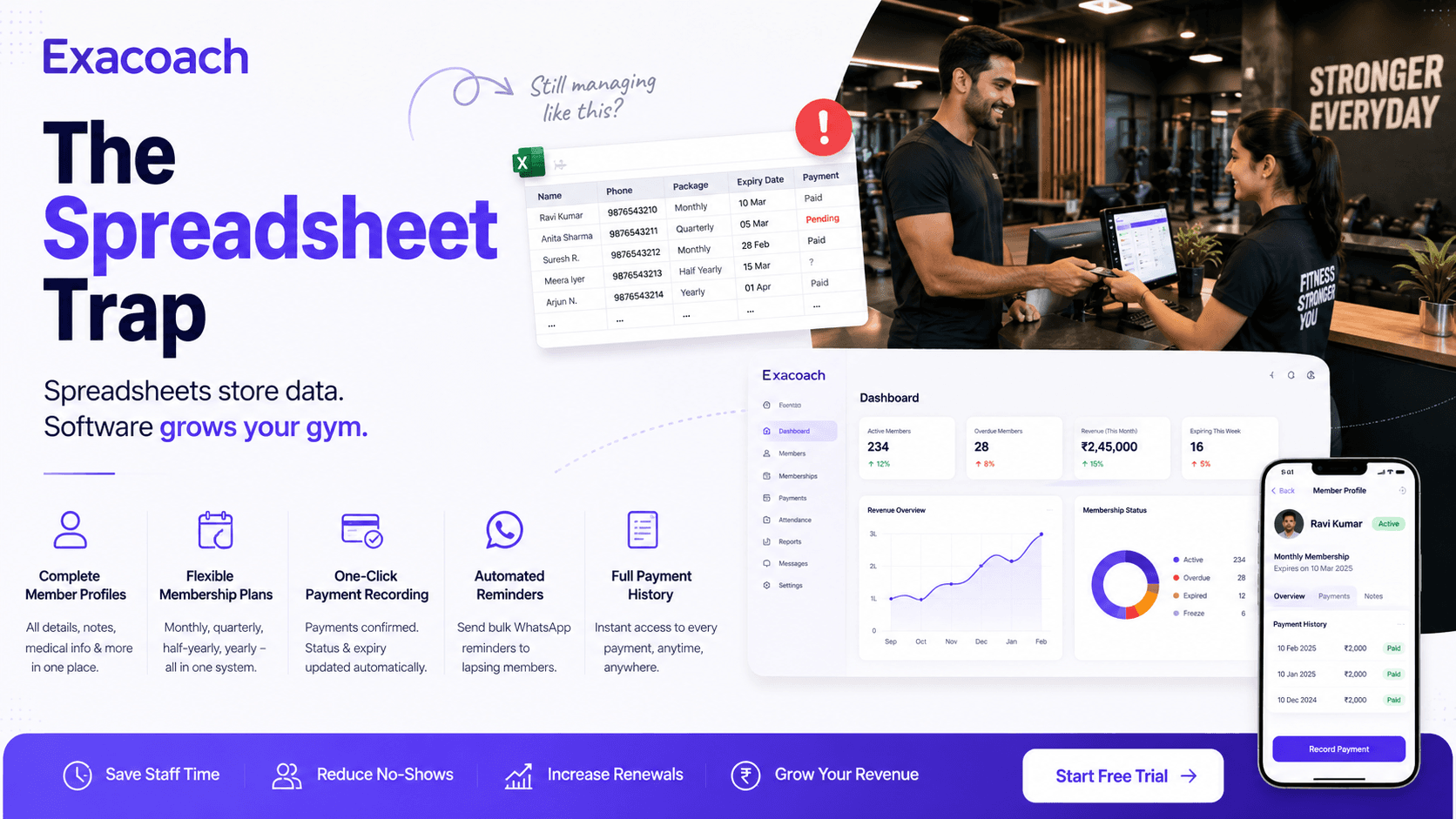
The Spreadsheet Trap
It starts innocently enough. You open a new sheet, add a few columns — member name, phone, membership type, expiry date — and you are off. It feels organised. It feels in control.
Then three months later, you have 200 members, two staff handling updates, a sheet nobody fully trusts, and a growing pile of unanswered questions:
- Who is about to expire this week?
- Did Ravi pay for March or not?
- Which members have not renewed in 60 days?
- How much revenue did we collect last month?
Spreadsheets are great at storing data. They are terrible at managing it.
What Gym Management Actually Requires
Running a gym is not a data-entry job — it is a relationships job. Your members expect to be known, reminded, and followed up with. Your staff need clarity on who is active, who is overdue, and what to do next. And you, as the owner, need real-time visibility into how the business is performing.
1. Member Profiles That Actually Tell You Something
A good member record is not just a name and a phone number. It includes emergency contact details, medical notes, a photo for front-desk identification, preferred timing, membership package, current status, expiry date, and full payment history. When a member walks in, your staff should pull up everything they need in seconds — not scroll through a shared spreadsheet hoping the last person remembered to update it.
2. Membership Plans That Reflect How You Actually Sell
Gyms do not sell one thing. They sell monthly memberships, quarterly plans, half-yearly and yearly packages. A spreadsheet cannot enforce these rules, automatically calculate expiry dates, or flag plans about to run out. A proper membership system handles all of this and keeps your packages consistent across every member record.
3. Payment Confirmation That Updates Member Status Automatically
Here is a common scenario: a member pays for a three-month membership. Your staff records the payment in one column, manually updates the expiry date in another, and changes the status in a third. Three separate edits — any one of which might get missed.
With a dedicated system, recording a payment automatically confirms it, updates the member status, and sets the correct expiry date. No manual cross-referencing. No member showing up to find their account marked unpaid when they definitely paid last week.
4. Overdue Tracking Without the Manual Chasing
Every gym has members who let their membership lapse. A good management system flags overdue memberships automatically and lets you send bulk renewal reminders via WhatsApp with a few clicks. In markets where WhatsApp is the primary communication channel, this is the difference between a renewal and a lost member.
5. Payment History at Your Fingertips
When a member disputes a payment or asks when their last renewal was, you need to answer immediately. A per-member payment history — with dates, amounts, package details, and payment method — is something spreadsheets handle poorly and management software handles well.
The Real Cost of Staying on Spreadsheets
Time. Every manual update, every cross-check, every moment spent searching adds up. Staff time spent on data housekeeping is time not spent on member experience.
Revenue leakage. Expired memberships nobody noticed. Members who lapsed because nobody sent a reminder. Payments not recorded correctly. Spreadsheets do not catch these — they just store whatever someone typed.
Trust. When two staff members disagree about whether a member has paid, you have a credibility problem. Systems create a single source of truth. Spreadsheets create multiple competing versions of it.
A growth ceiling. A spreadsheet that works for 50 members breaks down at 200. The operational overhead scales with your member count in a way that purpose-built software simply does not.
What Switching to Proper Software Looks Like
Moving off a spreadsheet does not have to be disruptive. With a platform like Exacoach, gym owners get:
- Member profiles with emergency contacts, medical notes, photos, and preferred timing
- Flexible membership plans — monthly, quarterly, half-yearly, yearly — linked directly to each member
- One-click payment recording that automatically syncs member status and expiry date
- Overdue tracking with bulk WhatsApp reminders to lapsing members
- Full payment history per member, always up to date
- A real-time dashboard showing active members, revenue collected, and renewal trends
- Role-based access so owners see everything, managers handle day-to-day operations, and coaches see what they need
And if you want to go further — enrolling members in structured coaching programs, managing multiple centres, tracking body measurements — it is all in the same platform.
The Bottom Line
Spreadsheets were never designed to run a gym. The difference shows up in every renewal reminder that did not go out, every payment not recorded properly, and every hour your staff spent on data entry instead of member service.
If your gym is growing — or you want it to — the question is not whether to move beyond spreadsheets. It is how soon.